Longacres Finance
The Biggest Mistake Investors Make? Interrupting Compounding
Most investors focus on chasing higher returns. But the real key to building wealth is far simpler: never interrupt compounding. This article breaks down how small, consistent investments can snowball into life-changing wealth over time and why patience matters more than most people realize.
People obsess over finding the next hot stock, beating the market, or squeezing out a few extra percentage points of return.
But the real secret to building wealth is much simpler.
Don’t interrupt compounding.
Compounding is often called the eighth wonder of the world for a reason. It quietly turns time into money. And the longer you leave it alone, the more powerful it becomes.
Most investors dramatically underestimate this.
The Difference Between Good Returns and Great Wealth
Let’s say you invest $100,000 and earn a 10% annual return for 20 years.
Without adding another dollar, your investment grows to roughly $672,750.
That’s 6.7x your original investment simply from staying invested and letting time do the heavy lifting.
Now here’s where it gets interesting.
What if instead of reinvesting your gains, you spent them every year?
How much would you need to earn annually to end up with the same $672,750 after 20 years?
Nearly 30% per year.
More specifically, 28.63%.
Think about that for a second.
Interrupting compounding means you suddenly need almost triple the return just to end up in the same place.
That’s the magic of compounding. And all it asks from you is patience.
Compounding Starts Immediately
A lot of people think compounding only matters later in life.
Not true.
Compounding begins the moment you invest your first dollar.
The problem is that early on, the effect feels tiny. Almost invisible. Which is why so many people give up before the snowball starts rolling downhill.
Let’s use a simple example.
Imagine you invest $250 per month into the market. That’s $3,000 per year.
Assume you earn a long-term average return of 10%.
Year 1
Your portfolio gains: $167.57
Of that gain, only $5.07 came directly from compounding.
Not impressive.
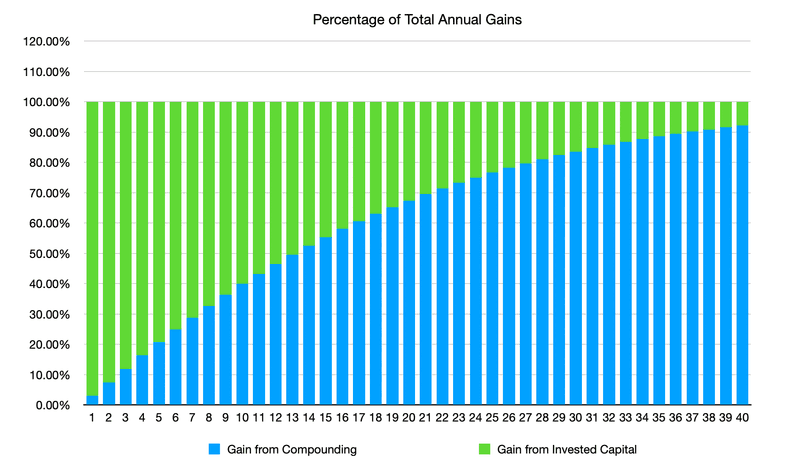
Only 3% of your gains came from your money making money.
Year 2
You contribute another $3,000.
This time your gains total $499.26.
Now compounding contributed $36.76, or 7.36% of your gains.
Still small. But notice something important:
The impact of compounding more than doubled in just one year.
Then the Snowball Starts Rolling
Year 5
Total invested: $15,000
Portfolio gains that year: $1,717.63
Compounding alone generated $355.13 of those gains.
Now over 20% of your yearly growth is coming from previous returns generating new returns.
The machine is waking up.
Year 8
Total invested: $24,000
Portfolio gains that year: $3,360.23
For the first time, your investments generated more money than you contributed.
That’s a huge milestone.
Your portfolio is now growing faster than your savings rate.
And nearly 33% of those gains came purely from compounding.
This Is Where Wealth Starts Accelerating
Year 12
Total invested: $36,000
Portfolio gains that year: $6,472.63
Compounding contributed $3,010.13.
Almost half your annual gains are now coming from previous gains stacking on top of themselves.
This is the phase where investing starts to feel different.
The market begins doing more work than you do.
The Final Stages Look Ridiculous
Year 20
Total invested: $60,000
Portfolio gains that year: $18,011.96
Over 67% of those gains came from compounding.
Year 30
Total invested: $90,000
Portfolio gains that year: $53,880.25
Compounding generated over $45,000 of those gains.
More than 83%.
Year 40
Total invested: $120,000
Portfolio gains that year: $150,977.20
And here’s the crazy part:
Over $139,000 of those gains came purely from compounding.
At this point, your $250 monthly contribution barely matters anymore.
The portfolio has become its own engine.
Most People Quit Before Compounding Gets Good
This is the real tragedy.
Compounding feels slow for years. Sometimes painfully slow.
The early stages are driven mostly by your own contributions, not market growth. That’s why consistency matters so much early on.
But somewhere around years 8 to 12, the equation changes.
Your portfolio starts working harder than you do.
And eventually, your investments generate more money each year than you need to contribute at all.
That’s when financial freedom becomes realistic.
The Goal Is Simple
Start as early as possible.
Invest consistently.
Stay invested.
And above all else:
Never interrupt compounding.